A modular platform for connected traffic systems

Digitraffic develops a modular Traffic Intelligence Platform that turns distributed real-time data into trusted, road-aware intelligence.

See how the platform works →

[ How it works ]

From connection to action

Traffic intelligence depends on more than collecting data. Information needs to be connected, understood and trusted before it can support prediction and timely action.

The platform brings together communication, traffic context, perception and operational trust in an architecture designed for edge devices, backend systems or both.

Its four products can work together as a complete platform or be selected individually to fit the customer’s system and use case.

The platform provides a structured path from distributed traffic systems and observations to information that connected services can use. Each step solves a different technical problem, from interoperability and message handling to entity resolution, operational trust and context-aware action.

1. Connect

Integrate vehicles, roadside equipment, sensors, traffic controllers and backend services across different interfaces and protocols.

3. Understand

Clean and correlate distributed observations into meaningful entities and road context.

5. Predict

Use observations, movement models and road context to project plausible movement between observations.

2. Communicate

Create, encode, transport, receive and interpret messages across standards and communication channels.

4. Trust

Verify message origin and integrity while maintaining confidence in the running service.

6. Act

Turn relevant intelligence into warnings, priority requests or other context-aware responses.

1. Connect

Integrate vehicles, roadside equipment, sensors, traffic controllers and backend services across different interfaces and protocols.

2. Communicate

Create, encode, transport, receive and interpret messages across standards and communication channels.

3. Understand

Clean and correlate distributed observations into meaningful entities and road context.

4. Trust

Verify message origin and integrity while maintaining confidence in the running service.

5. Predict

Use observations, movement models and road context to project plausible movement between observations.

6. Act

Turn relevant intelligence into warnings, priority requests or other context-aware responses.

[ Modular by design ]

One platform.
Your configuration.

Choose the capabilities each deployment requires and integrate them with existing systems.

The four products are designed to work together, but there is no fixed configuration. Link V2X can connect existing applications and data sources. Perception Engine can operate with a general road model, while Lanes adds more detailed lane-level context where needed. Monitor can provide operational visibility across deployed services.

This allows customers to start with what they need and expand the solution as requirements develop.

[ Cloud & Edge ]

Built for cloud and edge.

Digitraffic products are designed to run at the edge, in the backend or across both.

Processing can take place on resource-constrained roadside devices, centrally where information is consumed, or in a distributed configuration that combines both environments. This gives customers flexibility to place platform capabilities where they are needed within the deployment.

[ Technical foundation ]

Standards-based at the core. Proprietary where it adds value.

Digitraffic combines established C-ITS and V2X standards 
with its own technology for perception, road context, prediction and operational monitoring.

Depending on the deployment, Link V2X supports ETSI V2X message families, RSMP, DATEX II and SENSORIS/Data for Road Safety, together with communication paths including ITS-G5 and 5G V2X. This provides a standards-based communication layer that can connect vehicles, roadside infrastructure and backend systems. Perception Engine turns distributed observations into road-aware digital twins and maintains their context over time.
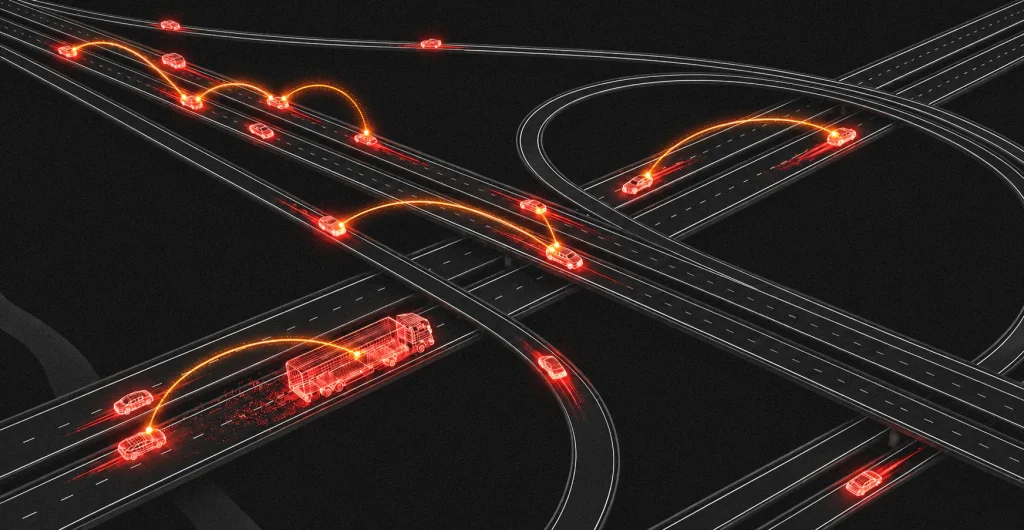
Its proprietary trajectory engine builds on Kalman-filter principles, extended with physical behaviour and road-network rules to project plausible movement between observations. Lanes adds routable, lane-level HD road context to improve matching and prediction where greater precision is needed. Monitor provides operational visibility, remote configuration and software management, helping teams keep distributed services manageable as deployments grow.

[ The products ]

Four products. One platform.

Each product solves a different part of the connected traffic challenge. Together, they provide a complete path from distributed observations to trusted information and action. Individually, they can add specific capabilities to an existing system.

/ Link V2X

Connect and communicate.
Provides standard interfaces for communication and message handling needed to exchange information between vehicles, infrastructure, applications and backend systems.

Explore Link V2X →

/ Perception Engine

Understand, predict and act.
Turns sensor and V2X observations into road-aware digital twins that can be interpreted, tracked and used to support prediction and connected services.

Explore Perception Engine →

/ Lanes

Add road context.
Provides a routable, lane-level road model that adds detailed context to observations, movement and traffic events.

Explore Lanes →

/ Monitor

Build operational trust.
Provides visibility into deployed services and orchestrates the configuration and maintenance of distributed installations.

Explore Monitor →