[Technology / Lanes]
Lanes
High-definition road network
Lanes is a routable, lane-level HD road model that describes where vehicles can actually travel.
It represents individual lanes, their geometry and how they connect, giving traffic observations and digital twins more precise road context than a carriageway-level model alone. Used with Perception Engine, that context can support lane-level matching, movement prediction and context-aware traffic services.
A coordinate does not explain how traffic can move
Vehicles can be close to each other geographically while travelling in different lanes, directions or traffic flows. A vehicle may overtake, change lanes or join a queue that affects only one lane. A road model represented as a single line cannot reliably describe those distinctions.
The same limitation makes sensor fusion harder. When a new observation appears, a system needs to determine whether it belongs to an existing track, another vehicle in an adjacent lane or an erroneous detection. Understanding the road at lane level adds context for making those decis
Lanes is a routable, lane-level HD road model that describes where vehicles can actually travel.
It represents individual lanes, their geometry and how they connect, giving traffic observations and digital twins more precise road context than a carriageway-level model alone. Used with Perception Engine, that context can support lane-level matching, movement prediction and context-aware traffic services.
A coordinate does not explain how traffic can move
Vehicles can be close to each other geographically while travelling in different lanes, directions or traffic flows. A vehicle may overtake, change lanes or join a queue that affects only one lane. A road model represented as a single line cannot reliably describe those distinctions.
The same limitation makes sensor fusion harder. When a new observation appears, a system needs to determine whether it belongs to an existing track, another vehicle in an adjacent lane or an erroneous detection. Understanding the road at lane level adds context for making those decisions.
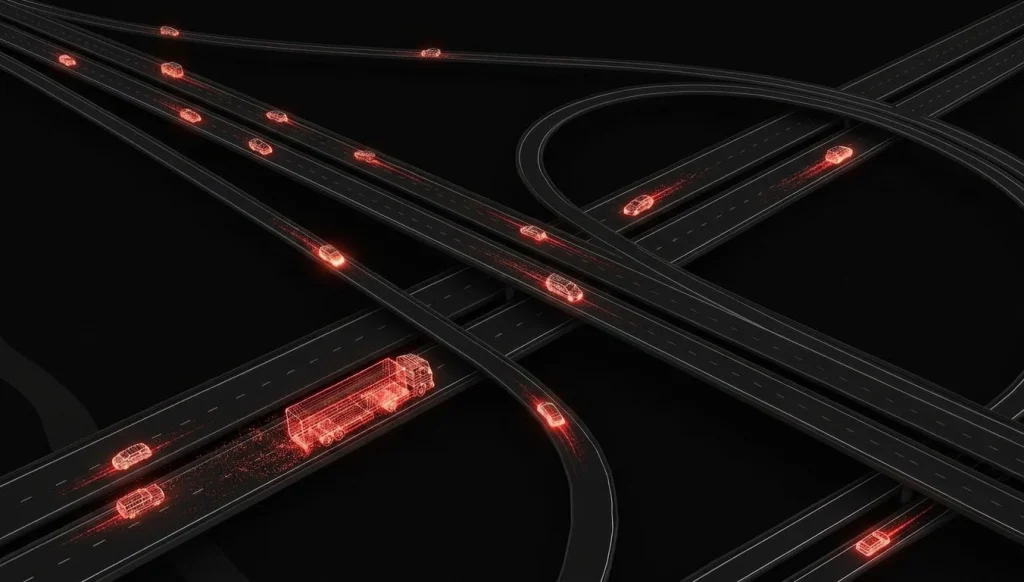
From road geometry to a routable lane-level model
Lanes turns road geometry into a routable model of individual lanes, their connections and the paths traffic can follow through the network. Instead of representing a road or carriageway as a single line, the model provides context for position, direction and movement at lane level.
This gives connected services a common representation of where an observation belongs and which movements are plausible within the road network.
Built from orthophotos and road-network data
Lanes combines geometry derived from orthophotos with a broader road network such as NVDB or OpenStreetMap. Orthophotos provide the basis for detailed descriptions of lane position, width, splits and other geometric features, while the underlying road network connects those details into routable paths.
The result is a lane-level road model that combines detailed local geometry with the connectivity required to understand how traffic can move through the network.
Decimetre-level road geometry
Lanes is designed to represent road geometry with decimetre-level precision. This gives traffic intelligence systems a more detailed basis for matching observations and constraining possible movement than a carriageway-level model alone.
Better context for matching and prediction
Lane-level context helps traffic systems determine where observations belong and how an entity can realistically move. With Lanes, Perception Engine has more context for distinguishing vehicles in adjacent lanes, associating new observations with historical tracks and identifying implausible or duplicated detections.
The road model can also constrain projected movement to plausible lane-level paths when new measurements are temporarily unavailable. Perception Engine remains responsible for maintaining the traffic model and projecting trajectories; Lanes adds the detailed road geometry that helps narrow the set of plausible movements.
From road context to service
Lane-level context also helps describe where an event actually matters. An event can be associated with the lane and direction it affects rather than only with a general road segment.
This gives downstream services more precise road context when presenting information, issuing alerts or determining an operational response.
Add lane-level precision where the application needs it
Lanes is an optional precision layer, not a requirement for every Perception Engine deployment. Perception Engine can operate with a less detailed road model such as OpenStreetMap, while Lanes can be added where lane-level tracking, matching and road context justify the additional detail.
This lets each deployment use the level of road context its application requires.
How Lanes fits into Digitraffic’s Traffic Intelligence Platform
Within Digitraffic’s Traffic Intelligence Platform, Lanes primarily strengthens Understand and Predict by giving observations and digital twins a more detailed representation of the road network.
Perception Engine can use that context for entity matching and trajectory projection, while Link V2X handles connected communication and Monitor provides operational visibility.